Inductance
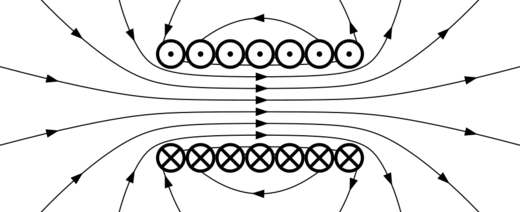
Inductance opposes changes in electric current via electromagnetic induction.

Inductance is the tendency of an electrical conductor to oppose a change in the electric current flowing through it. The electric current produces a magnetic field around the conductor, and any change in this magnetic field induces an electromotive force (voltage) that opposes the change in current, a phenomenon known as electromagnetic induction. Inductance is a fundamental property in electrical circuits, defined as the ratio of the induced voltage to the rate of change of current, and its unit in the SI system is the henry (H).
- field
- Electromagnetism
- unit
- henry (H)
- symbol
- L
- named_after
- Heinrich Lenz (symbol) and Joseph Henry (unit)
Lore & Background
The history of electromagnetic induction began with ancient observations of static electricity, lightning, and magnetic attraction. The scientific theory of electromagnetism was initiated and achieved during the 19th century. In his experiment, he wrapped two wires around opposite sides of an iron ring and observed a transient current in the second coil when a battery was connected or disconnected from the first coil. He also saw transient currents when sliding a bar magnet in and out of a coil and generated a steady DC current by rotating a copper disk near a bar magnet with a sliding electrical lead, known as Faraday's disk.
Reader's Guide
Inductance is a key concept in electromagnetism, representing the property of a conductor or circuit to oppose changes in current through it. This opposition arises from the induced voltage (back EMF) created by a changing magnetic field, as described by Faraday's law and Lenz's law. The inductance of a circuit depends on its geometry and the magnetic permeability of nearby materials; ferromagnetic materials like iron can increase inductance by thousands of times. An electronic component designed to add inductance is called an inductor, typically a coil or helix of wire. Inductance is also the basis for mutual inductance, where a change in current in one circuit induces a voltage in another, enabling devices like transformers.
Did You Know?
- The symbol L for inductance is used in honor of physicist Heinrich Lenz.
- The unit of inductance, the henry (H), is named after Joseph Henry, who discovered inductance independently of Faraday.
- A coiled wire has higher inductance than a straight wire because magnetic field lines pass through the circuit multiple times, creating multiple flux linkages.
Frequently Asked Questions
Who is Inductance?
Inductance is the inherent tendency of an electrical conductor to resist any shift in the current passing through it. It acts as a kind of electrical inertia, pushing back whenever the flow of charge tries to change.
What are Inductance's powers or role in the circuit?
When current flows, it generates a surrounding magnetic field, and any change in that field induces a voltage that fights the original change in current—a process called electromagnetic induction. Inductance is mathematically defined as the ratio of that induced voltage to the rate at which current changes.
How is Inductance measured and what symbol represents it?
In the SI system, inductance is expressed in henries (H), and the standard symbol used in equations is L. One henry corresponds to one volt of induced electromotive force per one ampere-per-second change in current.
Who is Inductance named after?
The unit of inductance, the henry, honors Joseph Henry, while the symbol L traces back to Heinrich Lenz, who formulated the directional rule governing the induced voltage. Both names anchor the concept in the history of electromagnetic discovery.
Why is Inductance important in electromagnetism?
It is a fundamental property that shapes the behavior of every inductive circuit, from transformers to radio-tuning coils. Without inductance, the interplay between electric and magnetic fields that underpins much of electromagnetic wave theory would lose a critical dynamic element.
More in Electromagnetism And Waves 1-23
Spotted an error? Know more?
This is a living reference — every entry is fact-audited, and reader corrections feed straight into our audit queue. Suggest an edit · See this site's audit record