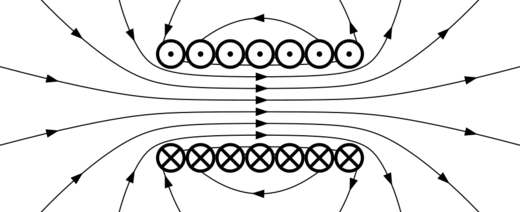
Lorentz force
Force on a charged particle by electric and magnetic fields.

The Lorentz force is the force exerted on a charged particle by electric and magnetic fields. It determines how charged particles move in electromagnetic environments and underlies many physical phenomena, from the operation of electric motors and particle accelerators to the behavior of plasmas.
- field
- Electromagnetism
- known_for
- Lorentz force law
- components
- Electric force and magnetic force
- key_contributors
- James Clerk Maxwell, Oliver Heaviside, Hendrik Lorentz
Lore & Background
The Lorentz force has two components. The electric force acts in the direction of the electric field for positive charges and opposite to it for negative charges, tending to accelerate the particle in a straight line. The magnetic force is perpendicular to both the particle's velocity and the magnetic field, and it causes the particle to move along a curved trajectory, often circular or helical in form, depending on the directions of the fields. Variations on the force law describe the magnetic force on a current-carrying wire (sometimes called Laplace force), and the electromotive force in a wire loop moving through a magnetic field, as described by Faraday's law of induction. Together with Maxwell's equations, which describe how electric and magnetic fields are generated by charges and currents, the Lorentz force law forms the foundation of classical electrodynamics.
Reader's Guide
The Lorentz force law is fundamental to classical electrodynamics, providing the equation of motion for charged particles in electromagnetic fields. It explains a wide range of phenomena, from the operation of electric motors and particle accelerators to the behavior of plasmas. The law remains valid in special relativity, but breaks down at small scales where quantum effects become important; in particular, the intrinsic spin of particles gives rise to additional interactions not accounted for by the Lorentz force. In practical applications, such as the motion of electrons or ions in a plasma, the effect of a magnetic field can be approximated as a superposition of a fast circular motion around a guiding center and a slow drift of that point. The magnetic force does no mechanical work on the particle, as it acts perpendicular to velocity. The law is expressed mathematically as F = q(E + v × B), with the electric force qE and the magnetic force q(v × B). Some sources use the term Lorentz force for the sum of both components, while others use it for the magnetic part alone.
Did You Know?
- The magnetic force is perpendicular to both the particle's velocity and the magnetic field.
- The direction of the magnetic force for a positive charge can be determined using the right-hand rule.
- The Lorentz force law breaks down at small scales where quantum effects become important.
From Maxwell's Equations to a Relativistic Framework
After Maxwell published his differential equation model of the electromagnetic field in 1873, a fundamental question emerged: what was the actual mechanism by which fields exerted their influence? The resolution came through a demanding requirement—that the equations must remain consistent no matter which moving observer examined them. This insistence gave birth to special relativity, a geometric theory of four-dimensional spacetime in which light and radiation serve as the mediating agents. Within this new framework, the old Coulomb force was generalized into the Lorentz force, and the resulting spacetime geometry furnished a coherent context for describing electric technology. Generators, motors, and lighting systems found their theoretical footing here, and the same principles extended outward to the development of transmission lines, power grids, and radio-frequency communication. The Coulomb interaction, once treated as a standalone force, became one facet of a broader relativistic picture where electric and magnetic phenomena are inseparable aspects of a single field structure.
The Frame-Dependence of Electric and Magnetic Fields
A central insight of relativistic electromagnetism is that what one observer calls a purely electric field, another in relative motion may perceive as a mixture of electric and magnetic components. In the simplest scenario, source charges sit at rest in one inertial frame. Knowing the electric field at a particular spacetime point in that rest frame, plus the relative velocity between frames, provides all the information needed to compute the field at the corresponding point in the other frame. Crucially, this calculation does not require the full spatial distribution of source charges; only the local field value matters. The electric field thus serves as a complete local summary of distant charges' influence. This perspective reframes magnetism itself. Introductory treatments introduce the Biot–Savart law to describe the magnetic field from an electric current. Yet an observer at rest with static, free charges detects no magnetic field. A moving observer, however, sees those same charges in motion—effectively a current—and perceives a magnetic field. In this reading, the magnetic field is simply the electric field re-expressed in a moving coordinate system, revealing the deep unity between the two phenomena.
Mathematical Formalism and the Geometry of Spacetime
The very title 'relativistic electromagnetism' carries a redundancy, because every mathematical formulation of electromagnetic theory is inherently relativistic. Einstein himself noted that special relativity was essentially a systematic development of the electrodynamics of Maxwell and Lorentz. The combination of spatial and temporal variables in Maxwell's theory demanded the admission of a four-dimensional manifold. Finite light speed and constant-velocity motion lines were described using analytic geometry, and the ordinary orthogonality of electric and magnetic vector fields in space was extended to a hyperbolic orthogonality for the temporal component. Faraday's law of induction had already been suggestive to Einstein when he wrote in 1905 about the reciprocal electrodynamic action of a magnet and a conductor. In modern language, the tangent space at any event in spacetime is a four-dimensional vector space operable by linear transformations. Using exterior algebra, one constructs a 2-form F from the electric and magnetic fields, along with its implied dual 2-form ★F. The equations dF = 0 and d★F = J then express the entirety of Maxwell's theory through a differential-form approach, giving electricians' observed symmetries a precise home in linear algebra and differential geometry.
Educational Legacy and Practical Electromechanics
His work examined the interplay of electric and magnetic fields as seen by observers in relative motion, showing how what appears as charge density in electrostatics becomes proper charge density and generates a magnetic field for a moving observer. This approach found renewed life in the 1960s when Richard Feynman's textbook sparked a revival of interest among educators training electrical and electronics engineers. Rosser's book, Classical Electromagnetism via Relativity, became widely popular, and Anthony French's treatment in his own textbook illustrated the concept of proper charge density through diagrams. One author captured the synthesis with the phrase 'Maxwell — Out of Newton, Coulomb, and Einstein.' Beyond the classroom, the practical fruits of this framework are substantial. The same mathematical structure that unifies electric and magnetic fields underpinned the development of transmission lines, power grids, and radio-frequency communication. The use of retarded potentials to describe electromagnetic fields generated by source charges stands as a direct expression of relativistic electromagnetism in engineering practice, bridging abstract spacetime geometry with the infrastructure of modern electrical technology.
Frequently Asked Questions
Who is Lorentz force?
The Lorentz force is the net push a charged particle feels when it sits inside electric and magnetic fields. It is named after Hendrik Lorentz, who formalized the expression, though the underlying field theory traces back to Maxwell and Heaviside.
What are Lorentz force's powers and role?
It has two components: an electric part (charge times the E-field) that accelerates the particle along the field, and a magnetic part (charge times velocity cross B) that bends its path sideways. Together they dictate every trajectory a charged particle can take in an electromagnetic environment.
How does Lorentz force's story end?
It never really concludes—it is a standing law that applies whenever charge meets a field. Its 'narrative' shows up in everything from a motor armature spinning to a beam of protons curving through a synchrotron.
Why is Lorentz force important to the broader canon?
It is the bridge between abstract field descriptions and the actual motion of matter, making it essential to electric motors, plasma dynamics, and particle accelerators. Without it, Maxwell's equations would describe fields but not tell you what those fields do to particles.
Who are the key contributors behind Lorentz force?
Hendrik Lorentz gave the force law its modern vector form, building directly on James Clerk Maxwell's unified field theory and Oliver Heaviside's reformulation of those equations into the compact notation we use today.
More in Electromagnetism And Waves 1-23
Spotted an error? Know more?
This is a living reference — every entry is fact-audited, and reader corrections feed straight into our audit queue. Suggest an edit · See this site's audit record